
Shopify vs WordPress presents a significant choice to consider.
Both platforms serve as strong options for creating e-commerce websites. However, determining the optimal selection hinges on your requirements and objectives.
To simplify matters, we will dissect the essential information to aid your decision-making process between e-commerce Shopify and WordPress for establishing your upcoming online store. 🛍️
Let’s delve into the details.
Factors Influencing the Choice between Shopify and WordPress
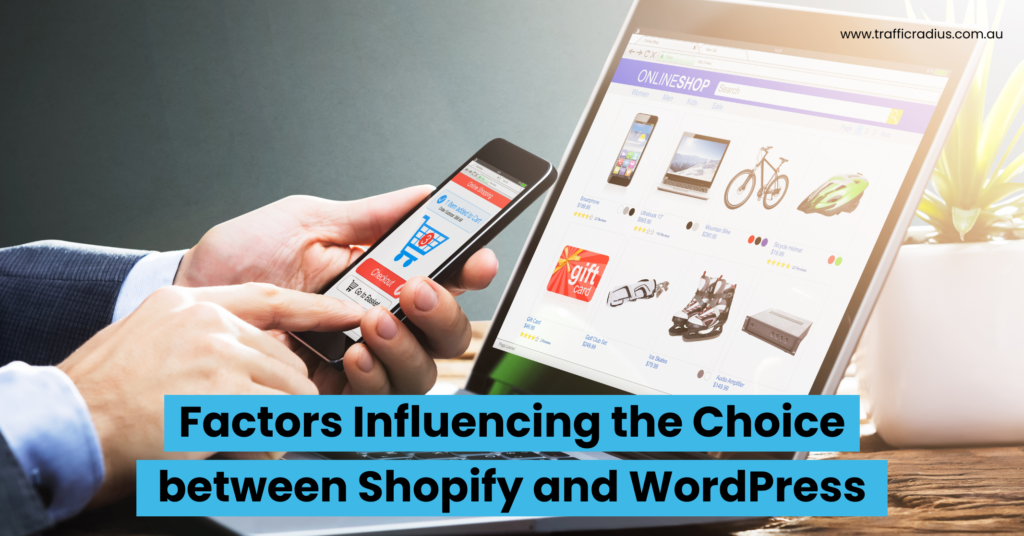
Shopify serves as an e-commerce platform tailored for individuals seeking a readily available solution to construct their e-commerce website. 🛒
This platform is ideal for people interested in creating an online store from scratch.
Here’s why:
- Shopify Handles Web Hosting: Shopify takes charge of web hosting, sparing you the intricacies of managing it independently.
- Swift Setup via Shopify’s Guide: Shopify offers a comprehensive setup guide that accelerates the process of getting your online store operational.
- Accessible Support Team: Shopify’s dedicated customer support is accessible through chat or messaging, and you can even request a callback while logged into your account. This ensures assistance is readily available.
- No Coding Expertise Required: Crafting an aesthetically pleasing and mobile-responsive store doesn’t necessitate coding skills when using Shopify.
- Streamlined Domain Acquisition: Shopify enables domain purchase directly through its platform, alleviating concerns about managing domains via third-party sources.
- Multi-Channel Selling Ease: Selling products across diverse channels like TikTok and Amazon becomes uncomplicated through Shopify’s integrated features.
Now, let’s delve into the difference between Shopify and WooCommerce:
- Shopify operates as a fully hosted platform, relieving users of the burden of hosting, security, and maintenance tasks.
- For access to their platform, a monthly fee is required.
- It is designed with simplicity in mind, Shopify serves as a user-friendly solution, even catering to those with limited technical proficiency. Its interface boasts an intuitive nature.
On the other hand:
- WooCommerce WordPress functions as a plugin tailored for WordPress. This implies that to utilise WooCommerce, you must possess your hosting and an existing WordPress website.
- While WooCommerce itself is free, expenses related to hosting and potentially other components need consideration.
- Integration within WordPress makes WooCommerce slightly more intricate, demanding a modest level of technical familiarity. For beginners, its usability might not be as immediately apparent, and they might need a WooCommerce setup guide.
Advantages of Opting for WordPress over Shopify
WordPress stands as a widely embraced platform for crafting websites, often selected by businesses to construct their e-commerce platforms. The key rationale for choosing WordPress instead of Shopify is that WordPress boasts exceptional flexibility and robustness, making it apt for handling more intricate websites.
Furthermore, WordPress is designed to grow alongside your business, eliminating the need to migrate to different platforms as your business expands. ✨
Here are additional motives to consider WordPress over Shopify:
- Diverse Array of WordPress e-commerce plugins: WordPress provides access to a multitude of plugins, allowing you to personalise your website extensively.
- Cost Management Control: With WordPress, you can maintain cost control by having complete authority over your chosen hosting provider and plugin selection.
- Enhanced Search Visibility: WordPress offers heightened control over your search engine ranking for relevant keywords, bolstering your online presence.
- Multilingual and Multi-Currency Support: WordPress empowers you to translate your site into an unlimited range of languages, each with distinct currency settings.
- Multisite Capability: WordPress’s Multisite feature facilitates the setup of multiple websites under one account, streamlining management.
Note: It’s crucial to differentiate between two WordPress versions—WordPress.com and WordPress.org. This discussion pertains to WordPress.org, commonly referred to as “WordPress” by most individuals.
Contrasting Shopify and WordPress Head-to-Head
Now, let’s conduct an in-depth examination of the distinctions between these two platforms.
Here are the specific aspects to ponder:
- Web Hosting: Before constructing a website, securing a dependable web hosting service is essential to ensure your site’s continuous operation.
Here’s the process:
- To make your site’s content accessible on the internet, you need a secure repository for all your files and data, such as images and website code. Web hosts maintain this content on servers, typically for a monthly fee, guaranteeing visitors can reach your site.
Shopify Benefits and Drawbacks:
Shopify website features include hosting services and managing storage for all your website’s files. This convenience proves advantageous for individuals who prefer to evade the complexities of sourcing and selecting a hosting provider. However, this convenience comes with certain trade-offs. 🛍️📝
- Opting for fully hosted services entails relinquishing some control over the server environment and configurations. For instance, troubleshooting issues independently becomes challenging without access to server logs. While this might suit some users who’d rather not tackle bugs themselves, others might prioritise this level of control.
- In contrast, WordPress places the onus on you to identify your hosting platform. This approach bestows greater control over your server environment, accompanied by an added fee. Hosting plans span a wide price range contingent on factors such as site size and incoming traffic.
Platform Interface and User Experience (UX)
Both Shopify and WordPress feature intuitive and user-friendly interfaces designed to facilitate navigation and efficient site management.
Now, let’s delve deeper into the user experience (UX) offered by Shopify and WordPress.
- Starting with Shopify: One notable aspect of Shopify is its setup guide, which aids users in crafting their online shops. This guide assists store owners in selecting templates, adding products to their store, and configuring all necessary elements to initiate product sales. Adding products is a straightforward process. It can be done individually or through bulk upload using a CSV file. On the other hand, establishing an e-commerce store on WordPress is slightly more intricate than on Shopify, as it requires an e-commerce plugin to facilitate product sales.
In terms of user experience, Shopify emerges as the more streamlined choice. The comprehensive setup guide efficiently leads users through each stage of the process.
However, those proficient in website development might not require such guidance.
Storefront Appearance and Customisation
Both Shopify and WordPress grant users the ability to craft a personalised storefront or opt for pre-designed themes from their respective collections.
Let’s explore the topic of themes, beginning with Shopify:
- Shopify boasts an array of over 140 themes at your disposal:
- Each theme is nearly ready for use upon installation. A simple alteration of text and branding suffices to align it with your business identity.
- With this streamlined process, you could have your storefront up and running within a matter of hours.
Transitioning to WordPress, a multitude of WordPress e-commerce customisation themes populate its library, numbering in the thousands. You can narrow down options by selecting the “E-Commerce” filter, thus highlighting themes specifically tailored for e-commerce ventures:
- Given WordPress’s flexibility, you hold the reins to customise virtually every facet of your site’s design. However, shaping a shop on WordPress might demand more effort.
- Most WordPress e-commerce themes necessitate refining before they’re ready for use and this process could extend to weeks or even months, particularly for those unacquainted with web design.
Fortunately, the option to purchase page-building plugins like Divi exists. These plugins provide pre-designed templates and drag-and-drop page builders to expedite the design process.
E–commerce Capabilities
Shopify and WordPress adopt distinct approaches to e-commerce functionality, and your choice should align with your requirements. 🛒🌟
In a broader context, both Shopify and WordPress enable you to:
- Vend physical and digital products.
- Tailor shipping rates to your preferences.
- Incorporate product customisation options.
- Implement discounts and promotional campaigns.
- Establish secure payment processing systems.
- Initiate and accept gift cards.
- Integrate with print-on-demand platforms.
- Employ cross-selling and upselling strategies to boost sales.
Shopify specialises in the e-commerce domain, equipping you with all the essentials to initiate and expand your online shop. Moreover, Shopify’s App Store categorises apps into various sections, streamlining the process of locating suitable free or paid apps to address your specific needs.
On the WordPress front, an extensive array of free and paid plugins is available, with over 1,000 plugins specifically tailored to e-commerce functions. However, Shopify’s categorisation system offers greater intuitiveness in locating the desired apps.
Expanding Sales Channels
Both Shopify and WordPress offer avenues to sell products beyond the confines of your primary e-commerce store, although the process is more streamlined with Shopify. 🌐🚀
Venturing into sales beyond your online store is known as “multi-channel commerce.”
Multi-channel commerce entails selling products through various avenues, such as:
- Online marketplaces like Etsy and Amazon
- Physical retail stores
- Temporary outlets like holiday markets
- Social media platforms such as TikTok, Instagram, and Facebook (Meta)
This approach ensures synchronisation across platforms, facilitating order and inventory management. For instance, if your weekend pop-up shop exhausts your scarf inventory, your website will automatically mark them as “out of stock,” obviating the need for manual updates.
Let’s explore Shopify’s capabilities in multi-channel commerce:
Shopify seamlessly integrates with Facebook, Instagram, and Handshake (a wholesale marketplace). For other platforms, additional apps are required. These apps enable product sales on:
- TikTok
- Etsy
- Amazon
- eBay
- Walmart
Moreover, Shopify links to point-of-sale (POS) systems, enabling in-person sales and payment processing at brick-and-mortar locations.
- Turning to WordPress, it’s also possible to establish connections with channels such as eBay, Amazon, and Google. However, configuring multi-channel commerce on WordPress is more intricate than the Shopify counterpart.
- The feasibility depends on the chosen e-commerce plugin. If you opt for WooCommerce, additional plugins must be downloaded to establish links with other channels. For instance, to vend products on Facebook, you must install the Facebook for WooCommerce plugin.
Moreover, if a POS integration is desired, another plugin is necessary.
A positive aspect of WordPress’s extensive plugin repository is the availability of free options, often providing the needed functionalities.
Search Engine Optimisation Capabilities
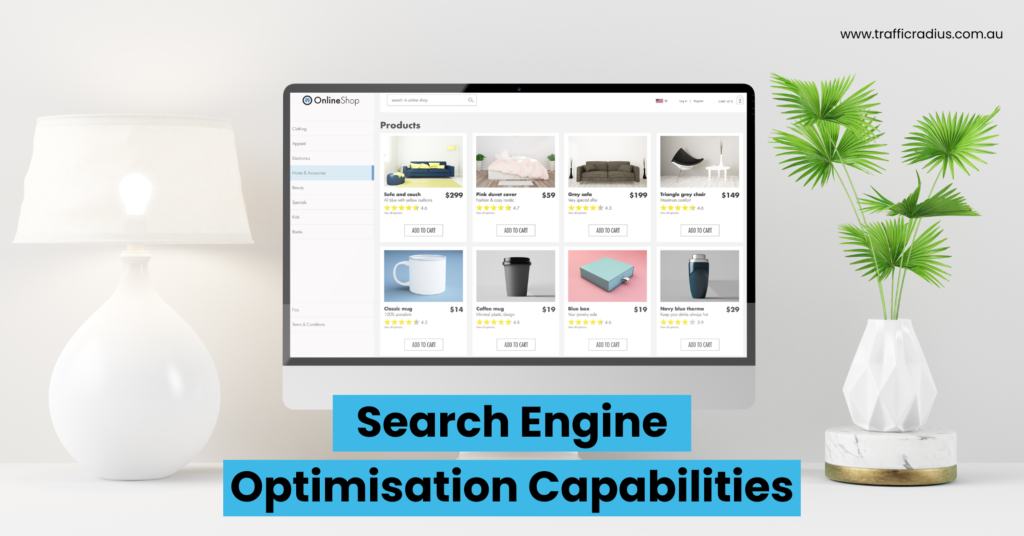
When it comes to search engine optimisation (SEO) capabilities, WordPress offers a higher degree of control compared to Shopify.
Why is this important?
- SEO plays a pivotal role in enhancing your visibility within search engine results, thus fostering organic traffic—unpaid visits driven by search queries—which ultimately leads to increased reach and sales potential.
Consider this scenario: You specialise in selling knitted cardigans. If someone enters “knitted cardigans” into Google’s search bar, your shop must appear on the first page of the results. Achieving this requires optimising your website for search engines.
- SEO encompasses various strategies, including enhancing the technical aspects of your site (referred to as technical SEO) and optimising individual pages (known as on-page SEO).
- Technical SEO: WordPress empowers users with greater technical SEO control. Technical SEO encompasses tasks like submitting your site’s sitemap to Google, structuring your website logically, and improving site speed.
For instance, WordPress users can personally choose their hosting provider to ensure optimal site speed. Additionally, they can edit configuration files like the .htaccess file, allowing custom code to be written for enhanced loading speeds. Such actions are not possible with Shopify.
Nevertheless, tools like Yoast, accessible for both Shopify e-commerce websites and WordPress, aid users in managing technical and on-page SEO aspects.
On-Page SEO: Both Shopify and WordPress offer robust on-page SEO capabilities, enabling users to fine-tune individual webpage optimisation.
Users of both platforms can:
- Craft custom title tags (the titles appearing in search results) and meta descriptions (text accompanying titles in search results) for each page.
- Optimise content with targeted keywords (relevant words and phrases for search ranking).
- Manage internal links (links within a page directing to another page on the same domain).
- Incorporate alt text (descriptions for images).
- Personalise URL slugs
Regardless of whether you choose Shopify or WordPress online store, keyword research can be conducted using the Keyword Manager tool.
Here’s how it works:
- Access the tool and click the green “Create List” button for automated keyword collection. (Manual input and import from other SEMrush tools are also available.)
- Enter seed keywords (general terms related to your products), select a country, and optionally input your domain. Click “Create a list.”
- Subsequently, you’ll encounter a roster of keyword clusters (collections of keywords pertinent to a specific topic).
- Select the clusters relevant to your blog posts and webpages, then click “Write content.”
- Choose your writing device (desktop or mobile) and click “Send keywords.”
This prompts the SEO Writing Assistant by SEMrush—a tool aiding content optimisation for search engines—to start. You can either paste or type your content in the editor.
The tool provides suggestions for enhancing originality, tone, readability, and SEO aspects of your content, serving as a valuable resource for content refinement. ✍️📊
For WordPress users, the SEO Writing Assistant plugin facilitates content analysis directly within the WordPress editor.
Compliance with GDPR Regulations
Both Shopify and WordPress offer tools to aid users in adhering to the stipulations outlined by the General Data Protection Regulation (GDPR).
The GDPR constitutes a collection of regulations formulated to safeguard the privacy rights and data of individuals within the European Union. 🛡️🔐
To align with GDPR requirements, certain actions can be taken, such as:
- Displaying cookie consent banners.
- Granting users, the ability to opt out of data collection.
- Establishing procedures for data deletion upon user requests.
- Notifying users in the event of data breaches.
Shopify users can avail of the Privacy & Compliance app to:
- Exhibit cookie consent banners.
- Enable users to opt out of data collection.
- Integrate a cookie preference banner for enhanced user control over data collection.
Similarly, WordPress presents diverse plugins that can be incorporated into your shop to ensure GDPR compliance.
Irrespective of your chosen platform, it is advisable to seek legal counsel to ascertain the specific actions your shop must undertake to align with privacy laws.
Creating Multilingual Websites
While both WordPress and Shopify offer multilingual functionality, WordPress provides a broader range of options for translating your shop into various languages, complete with distinct currencies. This feature is vital for delivering an enhanced user experience, as it allows for region-specific language and currency customisation.
WordPress e-commerce Site Examples:
If you have a German version of your website, visitors from Germany will view the site with prices denominated in euros.
- WordPress users can establish multilingual sites with diverse currencies using plugins like WooCommerce Multilingual & Multicurrency with WPML. The number of languages you can add to your WordPress shop is unlimited. However, keep in mind that incorporating an excessive number of languages might impact site speed, affecting SEO performance.
- Shopify simplifies the process of integrating multiple languages and currencies into your shop without necessitating the creation of separate versions. With Shopify’s Translate & Adapt app, you can infuse up to 20 different languages into your shop., Unlike Shopify, WordPress enables users to create multiple shops within a single account, a feature unavailable in Shopify.
Consider this scenario: You initiate a shop specialising in dog leashes, followed by another shop devoted to abstract artwork. Due to their distinct nature, it’s prudent to maintain separate sites for each niche.
- With Shopify, creating a new shop necessitates opening a new account, which might suit some users. However, for individuals overseeing multiple e-commerce ventures, the inconvenience of juggling multiple sites with unique login credentials can prove cumbersome.
- WordPress offers a Multisite feature, allowing seamless navigation between multiple sites within a single account. If you possess coding expertise, you can activate WordPress Multisite by incorporating the following line of code into your wp-config.php file:
define (‘WP_ALLOW_MULTISITE’, true);
Subsequently, configure your Multisite Network by accessing your WordPress site and navigating to “Tools” > “Network Setup.” Alternatively, tools like InfiniteWP enable efficient management of numerous sites.
Mobile Apps for Shop Management
Both Shopify and WordPress offer mobile apps that empower users to oversee their shops while on the move.
- Consider a situation where you’re away from your computer and an urgent need arises to withdraw a product from your shop—a response to issues with the manufacturer, for instance.
- Shopify’s complimentary iOS and Android app enables users to manage products, process orders, execute marketing campaigns, and engage with customers.
- For WordPress users employing WooCommerce, the WooCommerce Mobile App can be downloaded to generate products, supervise orders, print labels, and monitor statistics.
- Both WordPress and Shopify are suitable for mobile commerce. However, Shopify demands less effort to ensure your shop offers a seamless mobile shopping experience.
According to Shopify, nearly half of e-commerce transactions will occur via mobile devices by 2024. Consequently, facilitating convenient product purchases from customers’ phones is imperative.
To render your store mobile commerce-friendly, consider the following:
- Employ a responsive design that ensures ease of shopping on smaller screens.
- Optimise loading speed to prevent potential customers from departing before making a purchase.
- Incorporate mobile payment options.
- Responsive Design
All Shopify themes are designed to be responsive, guaranteeing an appealing appearance across various devices used by visitors.
Given the extensive variety of WordPress themes, it’s challenging to ensure the responsiveness of each one. Consequently, before implementing a theme, it’s essential to assess its responsiveness.
- Loading Time: Both Shopify and WordPress sites generally exhibit swift loading times. However, the speed of your site also hinges on factors such as uploaded files, integrated apps and plugins, and the selected theme. Addressing any issues causing slow loading falls within your realm of control.
- Mobile Payment: Shopify Payments offers instantaneous access to mobile payment options like Apple Pay without necessitating additional configuration.
With WordPress, compatibility with mobile payment options depends on the chosen e-commerce plugin. Renowned plugins like WooCommerce establish connections with mobile payment solutions.
Customer Support: In terms of support options, Shopify surpasses WordPress. For swift resolution of inquiries—ranging from instructions on connecting your digital store to a physical location to conducting a test order—directly contacting support proves effective.
- Shopify provides access to a support chat, the option to leave messages (including the possibility of requesting a callback), and a vibrant community for interactions among e-commerce Shopify users.
- Given the extensive support resources available, obtaining solutions to a wide array of queries becomes feasible.
- WordPress operates as an open-source platform, signifying that its code is publicly accessible and can be modified. Consequently, it does not offer the same level of support as e–commerce Shopify.
Final Decision: Shopify or WordPress?
If you’re still deliberating between Shopify vs WordPress SEO, a simple guideline can assist you: 🛍️📝
Opt for WordPress if you:
- Desire a highly adaptable website
- Possess coding expertise or financial resources for hiring assistance
Favour Shopify WooCommerce if you:
- Require a user-friendly approach for rapid website development
- Seek to evade coding involvement and lack the budget for hiring external help
Irrespective of your selection, utilising Site Audit post-launch is a prudent step to evaluate your website’s overall condition.