
In 2023, the page speed of your website has ascended to unparalleled significance.
Its ripple effects are profound, influencing everything from your site’s standing on search engines to the conversion rate of visitors. Thus, ensuring your web pages load with lightning-fast loading speed is non-negotiable.
In this enlightening guide, we’re set to unravel the mysteries of:
- What exactly do we mean by page speed?
- The intricate relationship between page speed and SEO – why is it so pivotal?
- Uncovering the golden standard: What’s the optimal loading time for SEO success?
- Delving into the problem: Why might your website speed need to catch up?
- The how-tos: Checking your page speed with precision.
- Mastery in action: Techniques to amp up your website speed and elevate user experience.
Dive in, and let’s make every second count!
What do we mean by ‘page speed’?
Page speed, in its essence, isn’t just about how swiftly a particular webpage loads. Instead, it encapsulates the overall website speed, portraying a holistic image of your site’s performance. With the evolution of digital marketing and emphasis on user experience, understanding page speed becomes quintessential
Often, when we talk about page speed, the narrative is multi-dimensional. Let’s dive into the different metrics that piece together the puzzle of page speed optimisation:
Understanding Time to First Byte (TTFB)
This metric zeroes in on the duration required to fetch the initial byte of data from your webpage. Think of it as the “first hello” from a website to its visitor. TTFB not only reveals the responsiveness of your server but is also a critical component in technical SEO. A lag in this could hint at server delays or issues with content delivery mechanisms.
What is Time to Interactive (TTI)?
Ever clicked on a button and felt like an eternity passed before something happened? That’s where TTI steps in. TTI gauges the interval needed for interactive elements (like buttons or forms) to become functional. A protracted TTI could often indicate heavy or improperly optimised JavaScript, which is a pivotal aspect of page speed vs UX. Simplifying or optimising scripts can lead to a significant boost here.
Decoding First Contentful Paint (FCP)
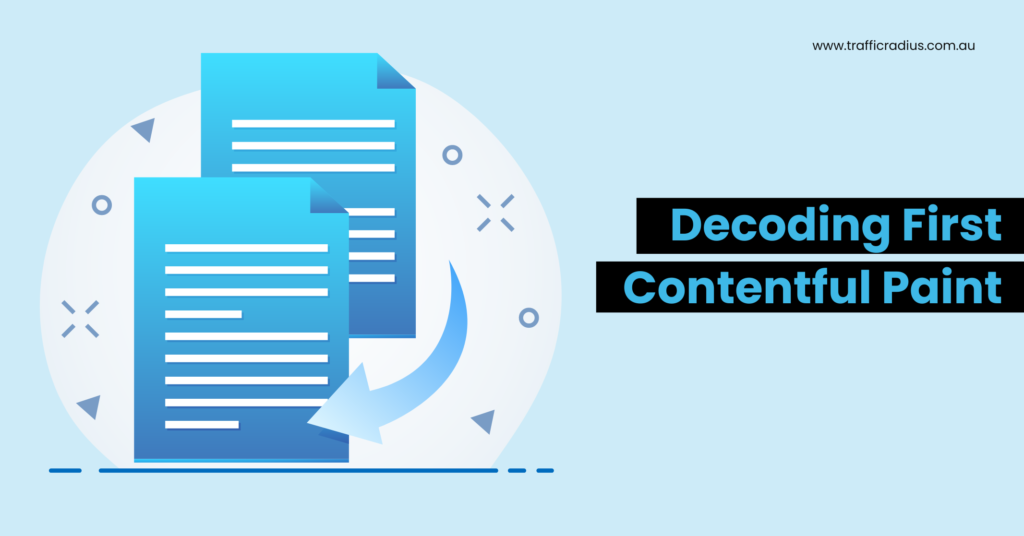
An oddly poetic term, FCP, also known as first contentful paint, describes the moment when the inaugural content element—be it text, an illustrative chart, or even an ornate banner—materialises on your site. It’s akin to the “first impression” your website offers. A slower FCP could indicate large image files or challenges in content retrieval, hinting at the need for speed optimisation.
What contributes to page load duration?
Arguably the most straightforward of the metrics, the load time denotes the span needed to present a fully rendered webpage to a visitor. From the first byte to the last image, it captures the entirety of the loading speed experience. Remember, a swift load time directly impacts conversion rate, as users tend to abandon pages that take less time.
Prioritising mobile responsiveness
Although not a direct measure of speed, the mobile-first approach has taken centre stage in search engines’ evaluation criteria, especially with tools like Google Lighthouse and PageSpeed Insights. Given our ever-growing reliance on mobile devices, tools predominantly assess the mobile rendition of websites. Speed becomes paramount on mobiles, where even minor delays can mar the user experience. Unfortunately, many miss out on page speed optimisation essentials tailored for mobiles, inadvertently hampering their site’s performance.
In a nutshell, if you’re looking to optimise website performance, delving deep into these metrics is a necessity. With SEO tips evolving and technical SEO gaining prominence, ensuring your website sails smoothly through these checkpoints is integral. And remember, “In the digital realm, speed doesn’t just influence traffic—it crafts experiences.”
Why does website speed hold significance in SEO?
The essence of page speed transcends mere loading metrics. It stands as a beacon in the realm of SEO, with the power to transform both user experience and conversion rate. Addressing page speed is akin to hitting a digital trifecta—it uplifts rankings, enriches user interactions, and boosts conversions. It’s no exaggeration to say that enhancing page speed is a “universal win” in the digital cosmos.
How website velocity affects SEO outcomes
In the intricate dance of SEO, page speed and overall website speed have risen as paramount influencers, deeply embedded in search engines’ evaluation criteria. The rationale is straightforward: platforms like Google, bolstered by tools like Google Lighthouse and PageSpeed Insights, are committed to delivering optimal results. In their pursuit to “serve the best to the rest,” they shun slow-loading content. Their prime objective? Showcase websites that are not only relevant but also swift and efficient in content delivery.
The correlation between load speeds and user experience
At the heart of search engines’ emphasis on speed lies an unwavering dedication to user experience. As the digital adage goes, “In the online world, patience is not a virtue.” Online visitors, constantly inundated with content, have attention spans that rival the fleeting nature of a shooting star. A delay surpassing 3 seconds in loading time? It’s a tricky zone. Such lags invariably lead to increased bounce rates, with users less inclined to “wait for the digital curtain to rise.” Fast-loading websites not only elevates user experience but also align with the ethos of search engines, which champion sites that enthral rather than repel.
How site speed can influence conversion rates
Beyond search rankings and user engagement, page speed wields a profound impact on conversion rate optimisation (CRO). Consider this: with each ticking second of loading speed, potential conversions might be slipping away, reminiscent of sand through fingers. Optimising website speed acts as a countermeasure, ensuring users aren’t left in a digital limbo, awaiting content to manifest. To put it briefly, a zippy website is a catalyst that not only scales SEO heights but also captures and converts wandering online gazes.
In summation, as you embark on the journey of page speed optimisation, remember this pivotal SEO tip: “In the universe of digital marketing, speed is not just a metric; it’s an experience, an emotion.” With evolving technical SEO tips and the continuous refinement of technical SEO strategies, prioritising page speed becomes more than just a recommendation—it’s a clarion call for digital excellence.
What’s the golden standard for SEO-friendly website speed?
What’s the magic number when it comes to page speed? The typical rhetoric leans towards a brisk 2 seconds or even swifter. Yet, the reality isn’t as black and white. The “ideal” speed often intertwines with the nature of your webpage and the metrics you prioritise.
The holistic user journey on your site only sometimes necessitates a full page load. Sometimes, it’s the time to interact (TTI) that captivates attention. Or it’s the first contentful paint (FCP), heralding the first glimpse of your content, that holds the key.
Surveying the typical website loading duration
With the vast spectrum of websites, each unique in its architecture and content, seeking an ‘average’ speed can be misleading. Comparing apples to oranges, as they say. Instead of being swayed by benchmarks:
Focus on your aspirations and industry best practices.
Aim for a loading speed under 2 seconds for vital metrics like TTI and FCP.
Remember, it’s your website’s performance that carves the user experience, not a generalised average.
Factors that might be slowing down your site
Navigating the digital realm, one might wonder, “Why does my site seem sluggish?” Here’s a deep dive into common culprits:
Is bloated code slowing your site down?
Code bloat or overhead is a recurrent issue, especially if platforms like WordPress are your go-to. A pre-built CMS comes laden with extraneous code, only sometimes pertinent to your specific needs. This excess baggage can be a drag on your website speed.
Asset management and its influence on speed
Visual assets, notably images and videos, significantly influence your loading speed. A prevalent myth? The notion is that uploading the highest resolution equates to supreme quality. While starting with high-quality images is commendable, the key lies in optimising file sizes for swift loading without compromising clarity.
The role of your hosting server in determining speed
At the heart of page speed optimisation lies a robust server. A glaring sign of a sub-par hosting service? A dismal time to the first byte. Even if your website’s content is perfectly optimised, a laggard server can dampen the user experience. Pinching pennies on hosting might seem prudent, but the trade-off could be the agility and safety of your website.
In summary, as you tread the path of digital marketing and technical SEO, bear in mind this SEO adage: “Speed is not just about time; it’s about the impression you leave in that time.” With tools like Google Lighthouse and strategies centred on page speed vs UX, ensuring your website is swift and seamless becomes an endeavour not just of optimisation but of excellence.
Assessing your website’s speed
In the sea of digital tools, few stand out as prominently as Google PageSpeed Insights when it comes to analysing page speed. After all, with Google’s dominance in search engines, leveraging their very own tool to assess your site’s performance is logical. Not only does PageSpeed Insights deliver a comprehensive speed score, but it also paints a clear picture of potential bottlenecks and offers actionable solutions.
For an even more granular perspective, the Experte Bulk Page Speed Test can be a game-changer. It meticulously evaluates every webpage, shedding light on metrics like TTFB, first contentful paint, and more.
Steps to enhance your site’s loading time
In the vast terrain of digital marketing, myriad strategies beckon to enhance website speed. Tackling some fundamental and widespread challenges can offer a substantial leap in performance:
Choose a reputable hosting provider

A great foundation makes a sturdy building. In the digital realm, this foundation is your web host. Ensure it’s responsive and reliable. And remember geography; if your primary audience resides in the UK, a US-based server might introduce latency. While data travels fast, proximity still plays a part in loading speed.
The advantage of static website generation
While platforms like WordPress offer versatility, they sometimes come at the expense of speed due to inherent code bloat. The solution? Static site generation. It proffers a “lightweight” version of your site, devoid of the cumbersome CMS backend, offering users a zippier experience.
Trim down image and document dimensions
An image might be worth a thousand words, but it should weigh less than a thousand kilobytes. Employ tools like TinyPNG to shrink image sizes without sacrificing quality. Also, consider adopting the WebP format, a modern image format that provides superior compression and quality. Just be ready with a fallback for older browsers.
Transition images to WebP format Try WebP converter for better image conversion!
The power of website caching
By allowing browsers to “remember” parts of your site, caching can drastically cut down subsequent loading times. For WordPress fans, several plugins can make this task a breeze.
Opt for code minification
Bloated code can be the anchor dragging your site’s speed down. Minifying code by removing unnecessary elements can give your page speed a much-needed boost. This might be more challenging with off-the-shelf platforms, but a custom-built website can be the answer.
Streamline website redirects
Over time, websites evolve. Yet, remnants of the past, especially multiple redirects or loops, can mire user experience. Streamlining redirects not only accelerates loading speed but also aids search engines in understanding your site better.
Leveraging a Content Delivery Network (CDN)
A CDN stores cached versions of your site on strategically positioned servers worldwide. This ensures users access your content from a nearby server, making content delivery brisker.
So, how does enhanced site speed benefit SEO?
In an emphatic voice, the answer resonates: YES! Beyond mere rankings, page speed intertwines deeply with user experience and conversion rate. Any holistic SEO or web development strategy prioritises page speed, often marking it as the “first line of defence”. If your site feels tardy, it’s time for a revamp.
If doubts cloud your understanding or if the desire to elevate your website’s prowess calls, reach out. Together, we’ll not only navigate the intricacies of page speed optimisation but also set your site on a path to digital excellence.
Reach out for more
Contact Traffic Radius to learn more about how you can speed up your website!