
As an SEO specialist, you’re aware of the significance of catering to user query intent. But what about those moments when internet users aren’t sure what information they need? Enter Google’s innovative solution: Google Discover, previously known as Google Feed, was introduced back in 2018.
Google Discover leverages its vast data on individual users to curate a personalised content feed, going beyond simple query-based responses. Exclusively available on mobile devices, this feature anticipates user preferences and interests, delivering valuable and interesting content proactively.
With a focus on user activity, Google Discover presents a powerful way to drive web traffic, offering a diverse array of content, from news, articles, and videos to advertisements and special rich results, such as live sports scores. It appears on Google’s homepage and tailors its content to suit the preferences of each user.
As machine learning and artificial intelligence continue to advance, this form of discovery is expected to become even more prevalent and accurate.
In this article, we’ll delve deeper into the world of Google Discover, exploring ways you can harness its potential for your benefit. 📱🔍
Understanding Google Discover’s Functionality
In the realm of Google’s content curation, Google Discover plays a vital role by making eligible content available once it has been indexed and deemed compliant with the content policies. Operating similarly to AI-driven video recommendations on platforms like TikTok and Facebook, Google Discover relies on a sophisticated algorithm to create a customised feed for its users.
The underlying principle of “query-less search” takes centre stage in Discover’s approach, where understanding individual users takes precedence over singular queries. Placing the user at the core, Google Discover automatically delivers personalised content based on various factors, including search history, browser history, app activity, and even location (depending on users’ Google account setup and privacy settings).
With a keen focus on individual interests, Google Discover leverages user data to identify and present topics it believes will be relevant to each user. 📱🔍
Identifying Intriguing Content
In the pursuit of comprehending Google Discover interests, our analysis encompassed a dataset of more than 700 interests, generously shared by SEO community members. Admittedly, this sample size is relatively small compared to the vast array of potential interests available on the platform. Nevertheless, our study yielded a few noteworthy observations that shed light on this intriguing aspect.
In the quest to gain a deeper understanding of Google Discover interests, an analysis was conducted on a dataset comprising over 700 interests thoughtfully provided by members of the SEO community. Although the sample size is relatively small in comparison to the vast array of potential interests on the platform, several noteworthy observations emerged.
Firstly, interests related to sports and entertainment surfaced as the most prevalent among the submissions. While some users found their Discover feed primarily focusing on updates about personalities like former Bachelor Peter Weber, others’ feeds were brimming with the latest sports news.
Secondly, Google Discover appeared to be predominantly focused on hobbies and leisure activities. Users were likely to encounter content aligned with their pastime passions, whether it be baking, beekeeping, or any other favoured after-work pursuit.
Additionally, brands and local businesses held a strong presence in the Discover feeds. Almost every submission featured specific brands or establishments, indicating that while Discover aims to suggest new content, it also caters to users’ preferences, remembering their go-to stores and restaurants.
Notably, the SEO category exhibited a dedicated following among the respondents. SEO enthusiasts expressed their interest in the subject, leading to its distinct category in the dataset.
The visual representation of all submitted user interests was thoughtfully organised by category (e.g., finance, education, etc.) and type of entity (e.g., brand, product, person, etc.), offering a comprehensive view of the diverse interests present on Google Discover.
Learn More: Google Helpful Content
Incorporating User Feedback
🔍 Users have the power to tailor their Google Discover feed to their preferences by providing direct feedback. They can effortlessly customise their content by following or unfollowing topics of interest, indicating “show more” or “show less” for specific content, and even opting out of seeing content from publishers.
💬 In some instances, Google might directly prompt users for their valuable feedback to enhance their Discover experience.
Optimising for Google Discover: Is it Feasible?
🔍 Optimising for Google Discover is indeed possible. As a personalised recommendation engine, Google Discover strives to deliver captivating and pertinent content to users based on their browsing history and interests.
🎯 To achieve optimal results, prioritise crafting top-notch, engaging content that resonates with your target audience. The key distinction between traditional search engine optimisation and Google Discovery optimisation lies in shifting the focus from queries to users.
⚡ While traditional SEO aims to cater to specific search queries, Google Discover caters to users’ interests without explicit search inputs.
📈 To boost visibility in Discover, publishers can take several strategic steps:
- Create high-quality, captivating content.
- Implement structured data to enhance articles.
- Publish content on trending topics.
- Utilise high-quality images and videos.
- Optimise for an excellent page experience.
- Uphold strong E-E-A-T (Expertise, Authoritativeness, Trustworthiness).
By following these tactics, you can increase your chances of succeeding in Google Discover and connecting with a broader audience. 🚀
Significance of Expertise, Experience, Authority, and Trust (E-E-A-T)
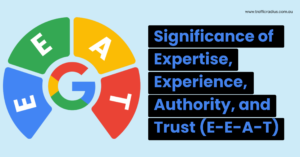
Google Discover, both on desktop and through its personalised feed, prioritises content that is not only interesting but also trustworthy, reliable, and credible. E-E-A-T (Expertise, Experience, Authority, and Trustworthiness) are the crucial elements guiding content suitability for recommendations.
To optimise for Google Discover, be selective, and prioritise topics that align with your expertise or your content creators’ expertise and experience. Focus on delivering valuable and relevant information in your niche to build authority over time, favouring long-term success over broad topics unrelated to your brand’s expertise. 📚🔍
To improve your E-E-A-T signals, follow these steps:
- Create High-Quality Content: Craft well-researched, accurate, and informative content that brings value to your audience. Avoid publishing misleading, sensational, or low-quality content that could damage trust. ✅📝
- Regularly Update Content: Indicate publication dates, update outdated articles, and annotate dates of updates as needed. Keeping content fresh and relevant enhances credibility. 🗓️📈
- Showcase Expertise: Highlight the credentials, qualifications, and experience of your authors or content creators. Including author bios, professional backgrounds, certifications, or industry recognition helps demonstrate expertise. 🏆👨💼
- Leverage Structured Data: Use Article and Author markup to provide annotated information to search engines, enhancing the visibility and understanding of your content. 🔍📄
- Cultivate a Reputable Track Record: Consistently publish relevant, high-quality content to establish a track record of consistency and build authority in your niche. 📚📊
- Ensure Transparency: Attribute sources, cite credible references, and be transparent about editorial policies, fact-checking processes, quality assurance, and any affiliations or sponsorships. Transparency builds trust. 👀🔍
- Improve Website Experience: Focus on factors like mobile-friendliness, page load speed, HTTPS, and overall website design to create trustworthy, user-friendly experiences. 👍💻
By following these steps, you can enhance your E-E-A-T factors, deliver valuable content, and establish a trustworthy and credible presence, significantly increasing your chances of being recommended in Google Discover. 🌟🔍
Learn More: Ultimate Guide to SEO Content Creation!
Dispelling the Myth: Google Discover Beyond News
Google Discover aims to offer users fresh content, predominantly featuring news items as users scroll through their Discover feed. However, when clients from various industries began observing Discover traffic in Google Search Console (GSC), further investigation became necessary.
To delve deeper, there was an analysis of 12 months’ worth of Google Discover news traffic encompassing over 11,000 URLs from 62 different domains. The breakdown of these URLs was as follows:
– 46% originated from news sites.
– 44% came from ecommerce sites.
– 7% were from entertainment sites.
– 2% belonged to travel sites.
– The remaining 1% comprised diverse industries such as B2B, automotive, education, finance, and health.
These findings highlight that Google Discover traffic extends beyond news content, encompassing a diverse range of industries, which could hold valuable opportunities for various businesses.
Research Insights
There are the research insights on Google Discover:
News Sites Garnered 99% Of Clicks
While news URLs accounted for less than half of the analysed content (46%), they received a staggering 99% of the total Discover clicks, surpassing other categories significantly in clicks per page.
One news domain in the analysis witnessed an impressive 30% of its overall web traffic originating from Google Discover, and other publishers have reported instances where Discover drove more traffic than organic search during certain months.
This discrepancy can be attributed to the likelihood that news content is showcased to a vast and diverse audience, while content from other industries is targeted at smaller audiences based on specific interests.
Google’s vision for Discover aligns with this observation, as they emphasise the importance of ensuring equal access to news content for everyone.
Takeaway: Google Discover serves as a substantial traffic driver for news publishers, granting them access to a wide and varied audience.
Blog Posts Prevalent Across Diverse Industries
For non-news websites, the remaining 1% of clicks, totalling over 1 million in the past 12 months, were distributed among various types of content.
Blog posts emerged as the most prevalent content type across different industries. Notably, blog topics displayed in the Google Discover feed were highly relevant to specific interests and hobbies, such as hiking, makeup, and nutrition.
Ecommerce sites received 49% of clicks on product pages, encompassing both product category and product detail pages.
Entertainment content witnessed the largest percentage of clicks (16%) on pages featuring videos as the primary content, such as cast interviews and movie trailers.
Travel sites garnered the highest percentage of clicks (53%) on pages promoting special offers, often related to limited-time travel or hotel deals.
Takeaway: Non-news content on Google Discover is primarily interest-focused, catering to a smaller yet highly targeted audience.
Discover Content Exhibits a Short Shelf-life
In line with Google Discover’s emphasis on presenting fresh content, most URLs studied witnessed traffic for only three to four days, with the peak occurring within one to two days after publication.
Nevertheless, some well-established, evergreen content managed to sustain longer-term traffic. This phenomenon arises from Google Discover’s practice of serving evergreen content to cater to evolving user interests.
In instances where we observed more mature, evergreen content appearing in the Discover feed, it correlated with previous searches on similar topics two to three days earlier.
Example of Evergreen Content in Google Discover on Desktop
Takeaway: While most pages featured in Google Discover have a brief shelf-life, lasting around three to four days, evergreen content has the potential to generate sustained traffic over a longer period.
Users Respond Positively to Discover Content
The high click-through rate (CTR) was one of the first noticeable aspects of Google Discover, reaching 11% across all analysed pages. However, when excluding data from news sites, which constituted a major portion of the dataset, the average CTR came down to 6%. Comparatively, for the same 62 domains, the CTR from traditional search stood at 4%.
It’s important to note that these CTR numbers cannot be directly compared due to the distinct measurement of impressions in Discover and traditional search:
– In traditional search, impressions are recorded for a URL when it appears on a search results page, regardless of whether the result is viewed by the user.
– In Discover, impressions are registered only when a Discover card is scrolled into view by the user.
Takeaway: Pages displayed in Google Discover tend to exhibit higher CTRs than those in traditional search. However, this difference may be attributed to the varying methods of measuring impressions, rather than a variance in user behaviour.
Connecting Effectively with Users on Google Discover
In the realm of traditional search, queries act as a bridge between a user’s specific need and the relevant content provided by search engines. For instance, when a user feels hungry, they might search for “food near me,” and Google would display local restaurants.
However, Google Discover operates differently by presenting content even before a user consciously realises their need. It achieves this by leveraging the strong alignment between an article’s content and a user’s interests.
Unlike traditional content creation processes that heavily rely on keyword research and query reports, Discover opens alternative avenues to enhance the likelihood of appearing in its feed.
Ensuring Mobile-Friendliness
Google Discover exclusively caters to mobile devices, making this aspect evident.
Nevertheless, it’s always prudent to be thorough by inspecting Google Search Console’s Mobile Usability Report to ensure a seamless experience without any errors. If any issues are identified, take prompt action to rectify them.
Focusing on Relevant Entities in Content
Interests encompass identifiable entities, objects, or concepts that hold unique characteristics.
These interests encompass a wide spectrum, ranging from broad hobbies to specialised niche topics, as well as specific brands and businesses.
By utilising the Entity Explorer tool from Marketer’s Center, you gain valuable insights into the interconnected relationships among various entities. This tool allows you to explore associations with your brand, industry, products, and more.
Capitalising on Trends
Google Discover operates similarly to a social networking platform’s feed, presenting content in a personalised manner to users.
To enhance your chances of being featured on Google Discover, monitor the latest trends and happenings on social media. Prioritise creating content around trending events and topics.
Ensure your website has optimised social sharing buttons, facilitating seamless content sharing across various social media platforms. This encourages broader exposure and engagement with your content on Google Discover.
Crafting Content that Engages Your Audience
🚀 Break free from the constraints of search volume and embrace this newfound freedom! 🌟
Now that you’ve pinpointed those crucial connection points, dive deep and get specific. Craft interest-based content that speaks directly to your most passionate users, ensuring a personalised experience. 🎯💬
To achieve this, explore intersections and relationships between topics. For example, consider creating content like “Best Ski Resorts near Pennsylvania” and “Running Tips for Winter.” 🏂🏃♂️
Bonus points await when you ingeniously tie your content into current events, keeping it relevant and engaging for your audience. 🎉📰
Remember, captivating Google page titles and offering Google helpful content are your allies in winning over users and succeeding in Google Discover! 📝🌟
Writing Compelling Page Titles
To boost your visibility in Google Discover, prioritise crafting Google page titles that precisely capture the essence of your content without resorting to clickbait tactics.
By doing so, you aid the algorithm in swiftly discerning the content’s subject matter and relevance to specific users. Clear and authentic page titles enhance your chances of appearing in Discover and connecting with your target audience effectively. 🌟📝
Incorporating High-Quality Images
In addition to producing captivating content for your users, a powerful approach to elevate your presence on Google Discover involves incorporating large, high-quality images. Ensure these images are at least 1,200 pixels wide and enabled with the max-image-preview: large setting or implemented through AMP (Accelerated Mobile Pages).
Steer clear of using your site logo as the primary image, as this may not be as appealing to Discover users.
For further insights on optimising images in Discover, explore Brodie Clark’s illuminating case study, “Google Discover: An Image Could Be Worth 1,000 Clicks.” 📷🚀
Rethinking Your Video Strategy
Videos play a significant role in Google Discover, reflecting Google’s emphasis on transitioning from text-centric to more visually appealing information discovery methods.
Although videos comprised only 17% of the content analysed, this doesn’t encompass data from YouTube, which hosts a substantial portion of videos featured in the Google Discover app.
While measuring the impact might be challenging, producing compelling videos and optimising your YouTube channel could be instrumental in elevating your brand’s visibility in Google Discover SEO. Moreover, this effort can also benefit your presence in traditional search results, where 19% of desktop searches include video carousels, with 92% of those videos originating from YouTube. 📹🔍🚀
Avoiding Sensationalism and Exaggeration
Google Discover’s primary objective is to furnish mobile users with pertinent and reliable information. It accomplishes this by penalising websites that employ misleading content or exaggerate details in their previews.
Likewise, any strategies aimed at garnering “cheap clicks,” such as using sensational or offensive content, should be steered clear of. To thrive on Google Discover, prioritise delivering valuable and authentic content that genuinely engages users. 📱🚫🗞️
Leveraging the Follow Feature
Google Discover offers a valuable Follow feature, enabling users to receive the latest updates from websites they choose to follow.
This feature, available in English to Chrome Android users, operates using RSS or Atom feeds as the default mechanism.
For websites with multiple feeds, optimising the Follow feature involves specifying the preferred feed in the <head> section to guide Google accordingly.
To ensure smooth accessibility of your feed, ensure it is not blocked in your robots.txt file, keep it up-to-date, and include essential elements like title and link attributes.
By following these steps, you can maximise the benefits of the Follow feature in the Google Discover guide and keep your audience engaged with your latest content. 🌟📱
Tracking and Analysing Your Performance
Once your content appears on Google Discover, you can track its performance using the Performance Report for Discover.
This report provides valuable insights into impressions, clicks, and click-through rates for your content featured on Discover within the last 16 months. Keep in mind that a minimum number of impressions is required for this data to be visible.
By utilising this report, you can assess the impact of your content on Discover and make informed decisions to enhance its reach and engagement. 📈📊🚀
Key Insights and Learnings
Google Discover presents remarkable opportunities for forward-thinking webmasters and SEO specialists, making it an avenue worth leveraging.
The beauty lies in its seamless integration with your existing strategies. Continue crafting high-quality content that resonates with your target audience. Ensure your content is indexed, and your website remains mobile-responsive – aspects that should already be part of your routine SEO efforts.
Keep in mind that optimising for Google Discover is an ongoing process, just like any other SEO endeavour. By adhering to the best practices discussed in this Google Discover SEO guide, your content stands a chance of being frequently chosen as an automatic recommendation to users by Google’s bots.
This translates to heightened visibility, increased traffic, and, ideally, a surge in conversions.
Seize the potential of Google Discover and let your content shine on this dynamic platform! 🚀📈📱