
FAQ pages offer a dual advantage of enhancing user experience and boosting your search engine ranking. Discover the art of locating, composing, and refining FAQs (frequently asked questions) to align with SEO principles. These pages serve as a crucial repository of pertinent data for your site’s visitors and search systems. 📚
When executed effectively, FAQ page templates and segments have the potential to furnish users with comprehensive solutions, a factor that aligns with Google’s ranking criteria.
Within this piece, we will illustrate the process of crafting valuable FAQs that serve the interests of your clientele as well as your own.
What is a FAQ Page and What Does it Entail?
An FAQ (Frequently Asked Questions) page refers to a webpage that provides solutions to questions frequently posed by individuals regarding a particular product or service offered on a website.
An effectively crafted FAQ page can play a pivotal role in enabling potential patrons to access comprehensive details about your brand and products before making a purchase.
Furthermore, there are supplementary advantages tied to SEO. 🌟
Why Establish an FAQ Page?
A well-structured FAQ segment stands as a pivotal repository of information on your website, offering many advantages for your clientele, brand and SEO efforts. 🌟
- It simplifies and expedites the buyer’s journey.
- By furnishing comprehensive solutions, you preempt the need for customers to engage with your customer support team, thereby eliminating wait times for responses.
- This streamlined process enhances the probability of users making purchases, owing to the reduced inconvenience. Additionally, it economises your time.
- A robust FAQ page for SEO that effectively addresses customer inquiries acts as the primary informational resource, diminishing the necessity for direct interactions with you.
- It aids in fostering transparency, a cornerstone of trust-building with customers.
- The quality FAQ section enables the dissemination of crucial information, such as shipping and return policies, cultivating loyalty between you and your buyers.
Why Do You Need A FAQ Page?
A FAQ page bolsters your website’s internal linkage. By incorporating links to pertinent content, the FAQ page facilitates seamless navigation, elevating the overall customer experience. These internal links also wield significance in terms of search visibility, elevating the prospects of attaining higher search result rankings. 📈
In cases where specific questions garner substantial attention, and your response aligns precisely with user intent, the likelihood of your content being featured as a snippet is heightened.
Do FAQ Pages Contribute to SEO? 🤔
Indeed, but the effectiveness hinges on proper execution.
Merely assembling a compilation of arbitrary questions accompanied by brief responses might not yield the intended outcomes.
A successful FAQ segment necessitates meticulous planning and meticulous keyword optimisation to maximise its SEO potential. Continue reading to explore the approach.
To establish a top-tier FAQ page, prioritising user-centric content becomes imperative, offering optimal solutions to prevalent inquiries from the customer’s perspective
Types of FAQ Pages 📋
Based on your inclination towards website design, you possess the flexibility to present your FAQ page in diverse formats. Each of these approaches effectively caters to furnishing your audience with the pertinent information they might seek.
We have delineated distinct categories of FAQ pages from an SEO perspective:
Considering your preferences in web design, you possess the versatility to present your FAQ page ideas in an array of formats. Each of these methodologies effectively caters to delivering pertinent information sought by your audience.
We have outlined distinct classifications of FAQ pages, considering SEO considerations.
- FAQs Embedded within Product/Service Pages
For specific products or services, you can introduce FAQs directly onto their respective pages.
- A Dedicated Page Exclusively for FAQs
Creating a standalone page dedicated solely to FAQs offers an excellent solution, particularly when dealing with a substantial number of queries. Like your homepage, this dedicated FAQ section can serve as a solid foundation for internal link integration, subsequently being referenced across various web pages.
- Inclusion of a Specialised FAQ Segment Concluding Blog Posts
Should you prefer to avoid crafting an independent FAQ page, consider integrating FAQs into your existing blog posts, ensuring alignment with the article’s subject matter.
A useful tip: You can amalgamate the previous two methods by providing concise answers within your blog articles, accompanied by an internal link to a dedicated FAQ page for more comprehensive responses to the same inquiries.
How to Identify FAQs?
The pivotal foundation of a valuable FAQ section rests upon the selection of questions you intend to address. The initial step involves locating these queries before commencing the page construction.
There are three effective approaches to uncovering your FAQs:
- People Also Ask
- Initiate a Google search using a pertinent keyword linked to your product or service.
- Navigate to the “People Also Ask” segment situated below the search results, featuring additional relevant inquiries related to your search term.
By selecting any of the suggested queries, you can access succinct answers alongside commonly posed questions, enabling you to discover pertinent FAQs tailored to your needs.
- Related Searches
On the same search results page, scroll down to the bottom, where you’ll find a compilation of related searches. These can provide more insights and information connected to your original search.
- Ahrefs’ Keyword Explorer
Leverage a keyword research tool like Ahrefs’ Keyword Explorer to delve into keyword research, aiding you in the formulation of your FAQs.
- Enter your relevant keyword and ensure to specify the accurate target location before initiating the search.
- Explore the search results and navigate to the “Questions” section.
- Click on “View All” to access an array of questions centred around your chosen keyword.
- To refine your results, employ more precise keywords for generating specific questions.
Placing Your FAQ Section on Your Website
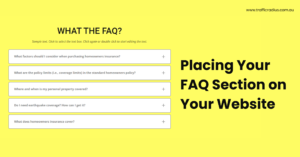
You have several options for where to integrate your FAQ section within your website. The choice will depend on the nature of your questions and their associations, allowing you to either embed them into existing pages or create a distinct page exclusively dedicated to FAQs.
When addressing pivotal questions tied to the same page or subject matter, incorporation into existing pages is advantageous. By presenting users with comprehensive answers within a single location, the need to navigate multiple pages for information is eliminated, thereby heightening the user experience’s quality.
For a collection of less pertinent questions revolving around the same page or subject, it’s advisable to forge a designated FAQ page. This approach facilitates responses to queries that may not warrant integration into core pages. Additionally, you can interlink your FAQ section with relevant pages to establish a coherent web of information.
Effective Practices for Optimising FAQ Pages for SEO
To ensure an exceptional browsing experience for your website visitors, it’s essential to make your FAQ page easily accessible and comprehensible.
When crafting your FAQ page, there are key aspects to consider:
- Search engines prioritise well-organised FAQ pages containing clear questions enriched with pertinent keywords. Employ a handful of straightforward techniques to enhance both user experience and search engine ranking:
- Categorise your questions to streamline navigation, enabling users to swiftly locate the information they seek.
- Maintain uniformity in your tone across the FAQ section, mirroring the writing style prevalent throughout your website to uphold brand identity.
- Employ straightforward language to ensure user comprehension, sidestepping jargon that might bewilder readers.
- Supply succinct responses to questions, recognising readers’ preference for efficient information retrieval. If depth is required, consider elaborating in separate blog posts.
Integrate internal links to connect your content with other relevant pages or external resources, fostering increased traffic and conversion potential.
Optimise meta titles, headings (H1) and meta descriptions, particularly when generating a dedicated FAQ page, to enhance the page’s search ranking.
Incorporate FAQ Schema Markup
An FAQ schema markup involves a specialised data format containing a compilation of questions and corresponding answers. By integrating this markup into your website’s code, you enable Google to interpret the content and generate informative snippets on the Search Engine Results Pages (SERPs).
You can seamlessly integrate an FAQ schema markup into your website through the following uncomplicated steps:
- Generate Your FAQs
Compile your set of questions adhering to Google’s stipulations, situating them within a dedicated FAQ page or a designated section within an existing page.
- Create Your FAQ Schema Markup
Utilise a readily available, no-cost online tool such as our FAQ schema Generator to produce your code. Copy and paste your questions and answers into the code generator, ensuring they mirror the content on your website precisely. Subsequently, paste the generated code into the Rich Results Testing Tool to assess its functionality.
- Apply the FAQ Schema to Your Page
Execute the final step of implementing the markup onto your webpage. You can achieve this through two commonly employed techniques:
- a) Manually insert the code within the <head> section of your page.
- b) Leverage a WordPress plugin like Insert Headers and Footers
After the integration is complete, reassess the functionality using the testing tool, as outlined in step 2. Moreover, inspect your page for errors by inspecting it within Google Search Console (GSC).
Enhance FAQs for Highlighted Snippets

As you’re already aware, skilful optimisation of your FAQ section provides an opportunity for improved search result rankings. Moreover, your website could secure a prime position at the pinnacle of search outcomes through the inclusion of featured snippets.
Featured snippets are succinct text segments showcased prominently atop the organic search results page, designed to furnish immediate responses to search inquiries.
These concise excerpts are directly extracted from websites. Of significance is the brevity of the snippet, typically comprising only a few sentences, aligning with Google’s objective to offer a succinct yet comprehensive response.
Securing the coveted featured snippet can significantly amplify your website’s click-through rate. Should users seek more extensive insights on a given topic than what the snippet presents, they are likely to visit your website for further information.
To fashion FAQ answers conducive to featured snippets, it’s crucial to: ✍️
- Convey Conciseness and Clarity
- Craft answers that are succinct and readily comprehensible, effectively addressing questions within 1 or 2 sentences. Strive for a structure conducive to voice search, emphasising simplicity.
- Align with Natural Language Processing (NLP) Norms
- Structure answers to adhere to the tenets of Natural Language Processing (NLP).
List of FAQ Page Best Practices 📋🔑
- Effective Keyword Integration: Embed pertinent keywords naturally within your FAQ queries and responses. This aids search engines in recognising the pertinence of your content to user inquiries.
- Structured Presentation: Systematise your FAQ page through lucid headings, bullet points and succinct answers. This elevates comprehensibility for both users and search engines.
- Thorough Encompassing: Tackle a wide spectrum of questions concerning your field or offerings. Supplying comprehensive responses augments your credibility and visibility.
- Captivating User Experience: One of the most effective FAQ page SEO strategies is fostering seamless browsing. Extended on-page interaction conveys value to search engines.
- Implementation of Schema Markup: Integrate FAQ schema markup to amplify your page’s prominence in search outcomes. This can lead to captivating rich snippets, enticing increased clicks.
Conclusion: Integrating the frequently asked questions page into your website proves advantageous, enhancing navigation and bolstering page visibility. When executed adeptly, these FAQ sections contribute to an improved user experience and heightened search result rankings.
A meticulously organised frequently asked questions page, replete with discerningly crafted queries and responses, can serve as a potent tool to excel in your SEO endeavours. Lastly, ensure you leverage the benefits of the complimentary FAQ Schema Generator at your disposal.